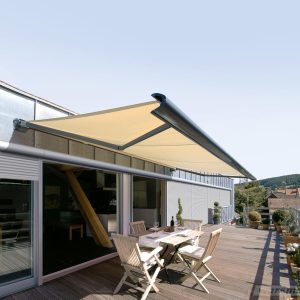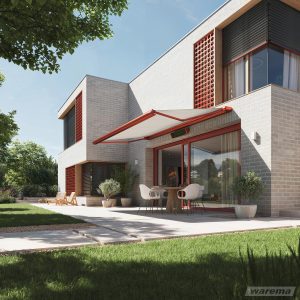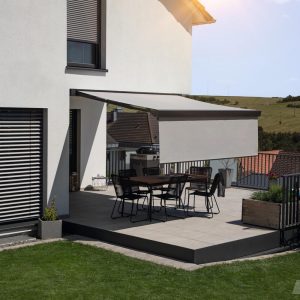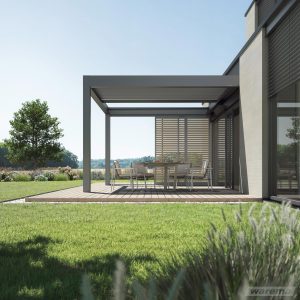
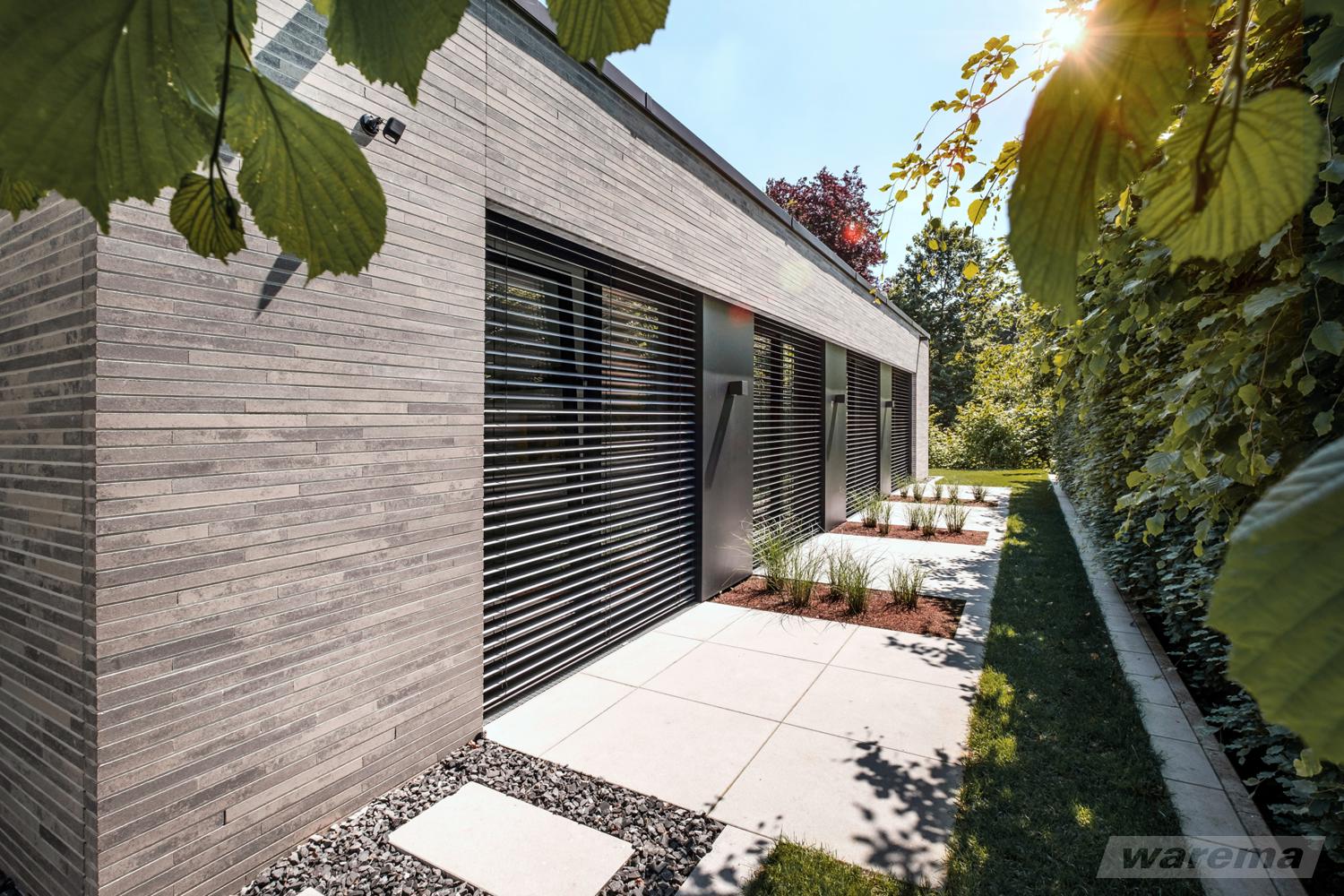
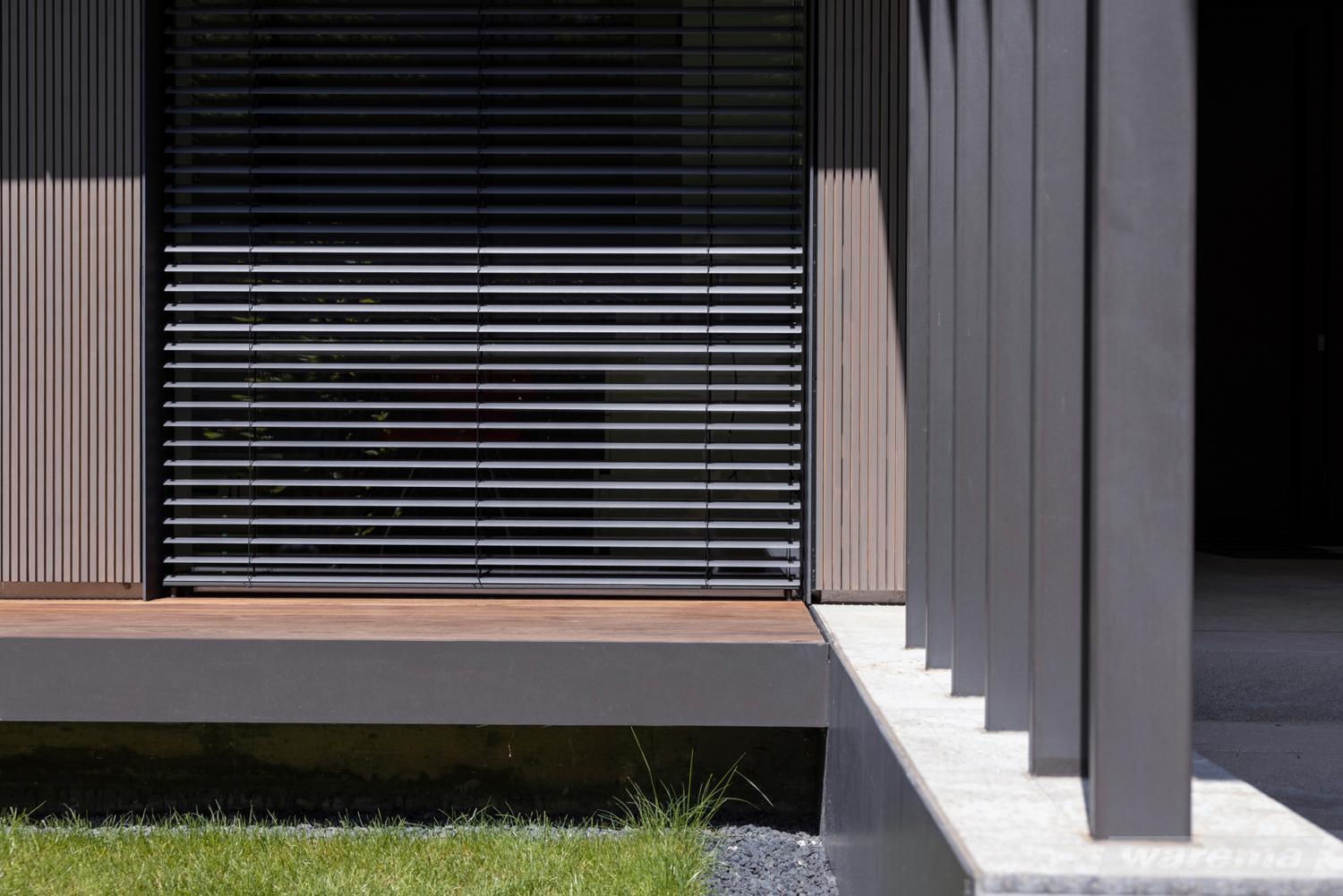
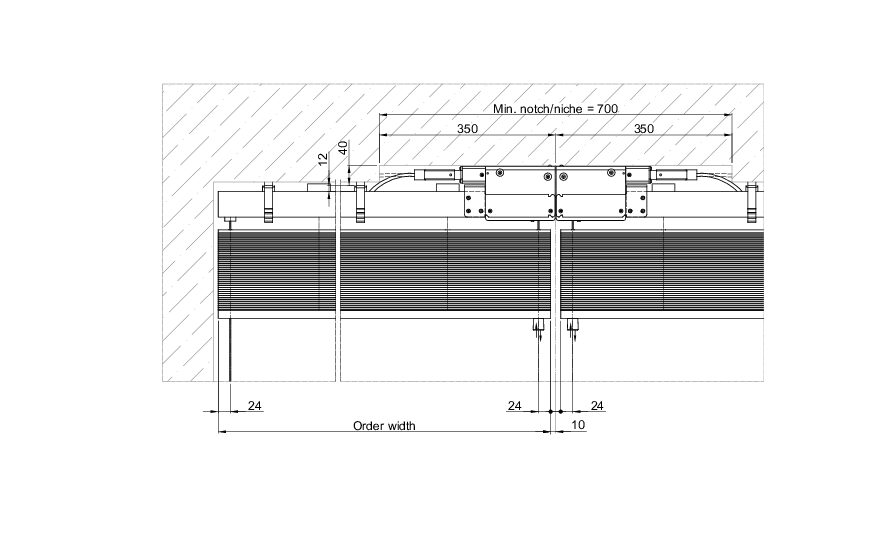

Internal blinds — however well specified — manage solar overheating after the event. By the time solar radiation has passed through the glazing and been absorbed by an internal blind fabric, the majority of the heat energy it carries has already entered the room. The blind reduces glare and light levels but it cannot undo the thermal conversion that has already occurred at the glass. External shading intercepts solar radiation before it reaches the glazing — acting on the energy before it becomes heat in the room. The difference in thermal effectiveness between an internal solar screen blind and an external blind on the same window can be measured in multiples, not percentages. Warema external Venetian blinds exploit this thermodynamic advantage fully.
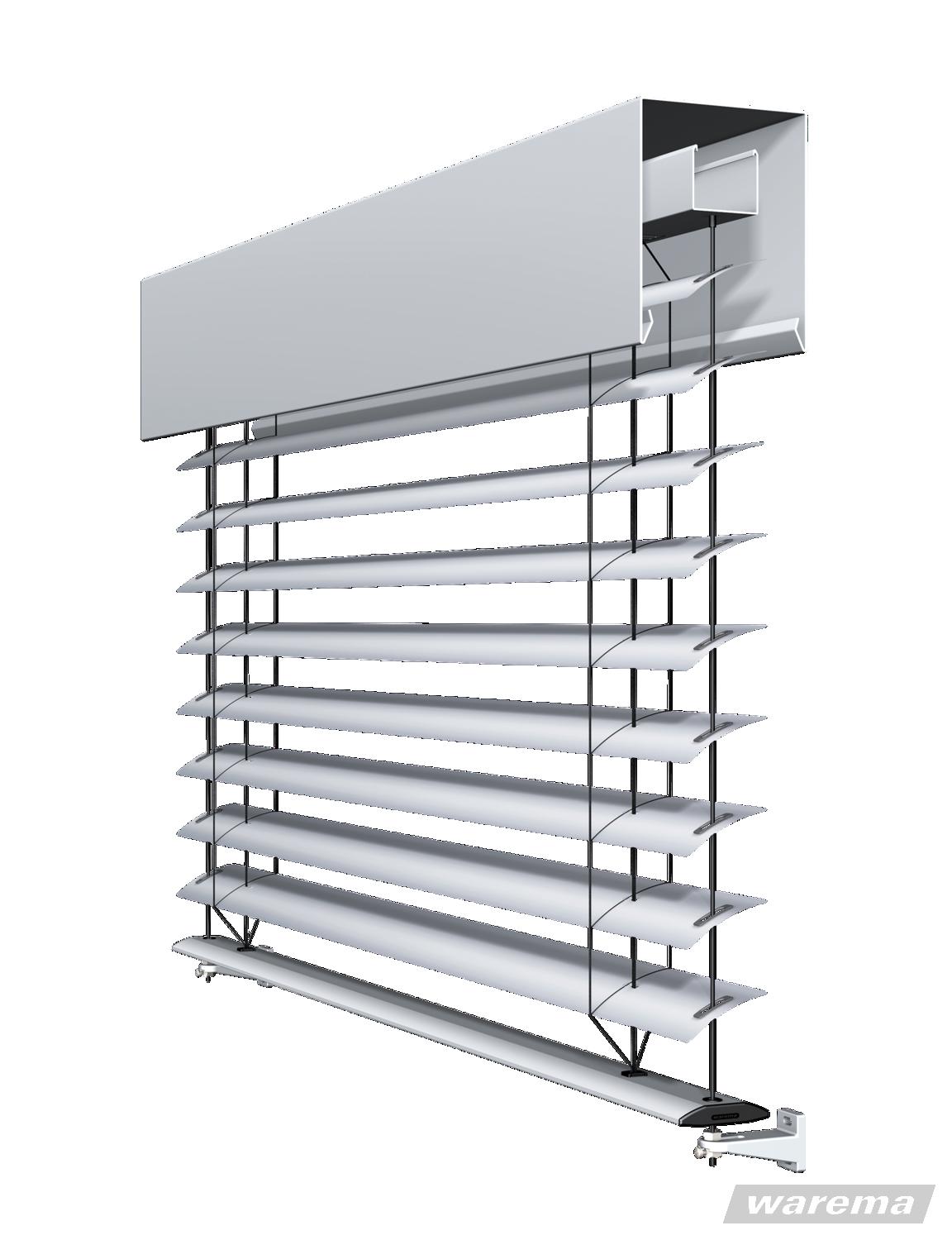
The Warema external Venetian blind uses motorised aluminium slats mounted within a guide rail system on the exterior face of the building. Slat angle is independently adjustable by motor, allowing the blind to be set to admit diffused daylight whilst excluding direct solar radiation — an intermediate slat position that no internal roller blind can replicate because it operates on reflected and diffused light rather than direct radiation. At the fully closed slat position, the Warema blind provides near-complete solar exclusion. At the fully raised position, the slats stack within a compact headbox with no obstruction to the view or the facade. Between these extremes, any slat angle is achievable and recallable as a programmed position.
Wind and sun sensors are integrated into the Warema system as standard on motorised installations, providing automatic retraction in high wind conditions that protect the slats from damage and automatic deployment in response to solar irradiance above a set threshold. Smart home integration allows the Warema blind to operate within the same scene and schedule programme as the building’s internal shading, lighting and climate control systems — closing automatically as part of a solar management routine and retracting at sunset or in response to changing weather conditions. As an authorised Warema dealer, we supply, specify and install Warema external Venetian blinds across Poole, Canford Cliffs, Sandbanks, Bournemouth and the wider Dorset and South Coast area, including structural fixing design, facade co-ordination with the main contractor and full electrical installation and commissioning.
For internal solar shading on windows where external installation is not possible, the Silent Gliss SG 4960 with solar screen fabric or the Lutron Sivoia QS roller blind range are the appropriate specifications. Contact our team for a free design stage consultation and Warema external shading specification advice.
Key Features
-External mounting — intercepts solar radiation at source
-Motorised aluminium slats — adjustable angle
-Near-complete solar exclusion at closed position
-Diffused daylight admitted at intermediate positions
-Wind sensor — automatic retraction in high wind
-Sun sensor — automatic deployment at solar threshold
-Smart home integration — scene and schedule control
-Compact headbox — no obstruction when raised
-Guide rail system — wind-stable operation
-Powder-coated aluminium — weather resistant
-Extensive RAL colour range
-Addresses Part O overheating compliance
-Contributes to BREEAM and Passivhaus
-Suitable for new-build and refurbishment
-Facade co-ordination and structural fixing
-Authorised Warema supply and installation
System: Warema motorised external Venetian blind.
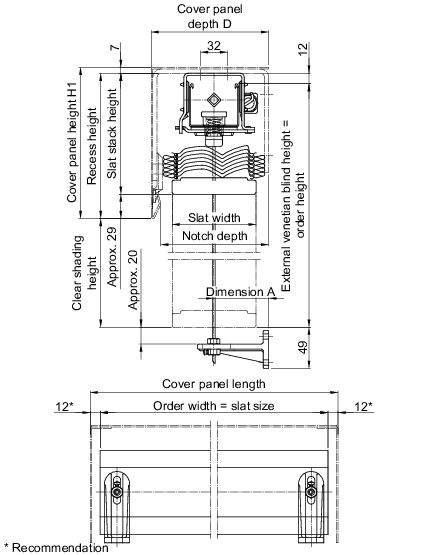
Slats: powder-coated aluminium — independently motorised for slat angle adjustment from fully open to fully closed. Guide rails: aluminium side guide rails — wind-stable operation throughout slat angle range. Headbox: compact powder-coated aluminium — slats retract fully; no obstruction to glazing or facade when raised. Motor: electric tubular motor — slat raise/lower and tilt; progressive start and stop. Wind sensor: integrated anemometer — automatic blind retraction above set wind speed threshold; confirm threshold with our team. Sun sensor: integrated pyranometer or radiation sensor — automatic deployment above set solar irradiance threshold; confirm threshold and orientation setting with our team. Smart home integration: Warema WMS (Warema Motion System) — app control, scene programming, group operation, schedule and sensor-triggered automation. Third-party integration: KNX, Crestron, Control4, Savant and other BMS platforms via WMS interface — confirm at specification stage. Colour range: extensive RAL powder-coat — confirm specific RAL with our team; facade colour matching available. Thermal performance: external mounting intercepts solar radiation before glazing — significantly more effective than internal solar screen fabric for preventing solar heat gain. Regulatory note: Warema external Venetian blind is an appropriate solar shading measure for demonstrating compliance with Part O (Overheating) of the Building Regulations; BREEAM Hea 04 credit contribution available — confirm with building control and BREEAM assessor. Structural fixing: facade fixing design confirmed during design stage survey — main contractor or facade contractor to install fixing substrate to confirmed specification. Installation sequence: facade fixing substrate by main contractor → electrical first fix → Warema system installation → sensor calibration → smart home commissioning. Supply and installation available across Poole, Bournemouth, Canford Cliffs, Sandbanks, Christchurch, Salisbury and the wider Dorset, Hampshire and South Coast area. NBS specification text, thermal performance data, wind load calculations and product data sheets available on request from our specification team.
FAQ
What is a Warema external Venetian blind?
A Warema external Venetian blind is a motorised aluminium slat system mounted on the exterior face of the building — outside the glazing — that intercepts solar radiation before it passes through the glass and enters the room as heat. The slats are independently adjustable by motor, allowing any angle between fully open (maximum light and view) and fully closed (near-complete solar exclusion). Integrated wind and sun sensors automate the blind’s response to changing weather conditions, and smart home integration allows it to operate within the building’s wider shading and climate control programme. We supply and install Warema external Venetian blinds across Poole, Canford Cliffs, Sandbanks, Bournemouth and the wider Dorset and South Coast area as an authorised Warema dealer.
Why is external solar shading more effective than an internal solar screen blind?
An internal solar screen blind reduces glare and controls light levels, but it operates after solar radiation has already passed through the glazing. By that point, the majority of the heat energy carried by direct solar radiation has been absorbed by the glass and re-radiated into the room as long-wave heat — a process that an internal blind fabric cannot reverse. External shading intercepts the solar radiation on the outside of the glazing — before the thermal conversion occurs — reflecting or absorbing it before it reaches the glass. The result is a dramatically lower solar heat gain through the glazed area compared with any internal shading solution. On south and west-facing glazing in summer, the difference between an external blind and an internal solar screen blind on the same window can reduce peak room temperatures by several degrees — a difference that is immediately perceptible and that no internal blind, however well specified, can match.
Does a Warema external Venetian blind comply with Part O of the Building Regulations?
Yes. Part O of the Building Regulations — which addresses overheating in residential buildings — requires that buildings demonstrate either compliance with the simplified method or a dynamic thermal modelling assessment showing acceptable indoor temperatures. External solar shading is one of the most effective measures available for reducing peak solar heat gain through glazing and is widely used by architects and building control consultants to demonstrate Part O compliance on south and west-facing residential glazing. The Warema external Venetian blind, with its motorised slat angle adjustment and sensor-automated operation, provides a measurable and documentable solar shading contribution that can be included in Part O calculations. We can provide solar shading performance data for specific Warema system configurations on request, and we work with architects and building control consultants during the design stage to confirm the appropriate specification for the specific glazing orientation and building type.
How does the wind sensor work on a Warema external blind?
The wind sensor — an anemometer — continuously monitors wind speed at the building facade and signals the Warema motor controller to retract the blind automatically when wind speed exceeds a set threshold. This automatic retraction protects the aluminium slats from wind damage at elevated positions and prevents the guide rail system from being stressed by lateral wind loading on an extended blind. The wind speed threshold is set during commissioning and can be adjusted to suit the exposure of the specific building and facade orientation. When wind speed drops back below the threshold and conditions are suitable, the blind can be programmed to redeploy automatically or can be recalled manually via the Warema WMS app or building management system. Sun sensor automation operates on the same principle — deploying the blind when solar irradiance exceeds a set threshold and retracting when the threshold is no longer met.
Can Warema external blinds be integrated with a smart home or BMS system?
Yes. Warema external Venetian blinds integrate with smart home and building management systems via the Warema WMS (Warema Motion System) platform, which provides app control, group operation, scene programming and sensor-triggered automation as standard. For integration with KNX, Crestron, Control4, Savant and other BMS platforms, the WMS interface provides the appropriate connection points — we confirm the compatible integration method for the specific control platform at the specification stage and work directly with AV integrators and BMS engineers on wiring co-ordination and commissioning. On projects where Warema external blinds operate alongside Lutron or Silent Gliss internal shading, the two systems can be programmed into co-ordinated daily scenes — external blinds deploying in response to solar gain whilst internal blinds adjust independently for privacy and light quality.
Do you install Warema external Venetian blinds in Poole and across Dorset?
Yes. We are an authorised Warema dealer supplying and installing Warema external Venetian blinds and external solar shading systems across Poole, Canford Cliffs, Sandbanks, Bournemouth, Christchurch, Salisbury and the wider Dorset, Hampshire and South Coast area. Every installation begins with a design stage consultation to confirm the facade fixing requirements, glazing orientation, slat specification, sensor configuration and smart home integration. We work directly with architects, main contractors and AV integrators from the design stage to completion.